


What you will find here
At Exlibrismo.com we gather clear guides and examples to understand and enjoy book ownership marks: from the exlibris (the inner label or print) to the superlibris (the outer mark on the binding), the ex dono (donation note) or fire marks (on the edge).
Our approach is twofold: cultural (history, styles, symbolism) and practical (how to choose a design, techniques, size, conservation and collecting).
Start here
Who this website is for
- Bibliophiles and collectors
- People who want to mark their library
- Curious about engraving and design
- Research and documentation of copies
If you're only going to read one page today: What is an Exlibris.
Last update of this homepage: .
Quick guide: how to recognize ownership marks
When you open an old book (or an inherited library), these clues help you identify what type of mark you are seeing:
1) Where is the mark?
Inside: usually exlibris or ex dono.
Outside: usually superlibris.
Edge: frequently a fire mark.
2) Is it printed or handwritten?
Printed/Stamped: artistic or typographic exlibris.
Handwritten: ex dono, ownership note, old signatures.
Blind or gilt: superlibris on the cover.
3) What does the text "say"?
Ex Libris / Ex Bibliotheca: bibliographic ownership.
Ex Dono: gift or donation.
Initials / monograms: abbreviated identity.
If you want to delve into examples with images and context, the main guide is for you: What is an Exlibris.

Exlibris Collecting
The exlibris is collected for its artistic value, its rarity and the history it preserves: names, libraries, lineages, artistic movements and printing techniques. A good collection is not just "many exlibris", but a well-documented collection.
- How to start: theme (author, style, country, period) and budget.
- What to record: author, technique, date, provenance, condition and measurements.
- Conservation: acid-free sleeves, humidity and light control.
Next recommended step: see authors and styles in the gallery.

Monograms
Monograms are compositions of initials (sometimes intertwined) that function as a visual signature. In exlibris and ownership marks they provide elegance and legibility even in small sizes.
Useful if you want a discreet, modern design or one easily repeatable in various formats.
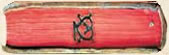
Fire marks
Fire marks were applied with a hot iron to the book's edge to identify convent and institutional libraries. Their advantage was immediate: the book could be recognized on the shelf without opening it.
Today they are a valuable clue to the copy's history and provenance.
Quick comparison
In one view: what each mark is, where it appears and what it was used for.
| Mark | Where | Function | Typical clue |
|---|---|---|---|
| Exlibris | Inside (endpaper/first page) | Ownership + visual identity | "Ex Libris" + name |
| Superlibris | Outside (cover) | Visible ownership + prestige | Gilt / blind |
| Ex Dono | Inside | Memory of a donation | Handwritten/printed note |
| Fire mark | Edge | Shelf identification | Burnt symbol/monogram |
For examples and context, expand in: What is an Exlibris.
Frequently asked questions
Is an exlibris the same as a stamp?
Not exactly. A stamp is a tool for stamping ink; the exlibris is usually a print or label (although it can also be made as a stamp). What matters is its cultural function: ownership mark and, often, graphic artwork.
Where is it correctly placed?
On the endpaper (inner cover page) or on a first blank page. Avoid pages with printed text and use neutral adhesives if the book is valuable.
What size is recommended?
As a general guideline, between 6 and 10 cm wide. The name should be readable and it should not "invade" the book. We detail it in Create your exlibris.
How do I start if I want my own?
Define the text, choose a main symbol, decide on the technique (traditional engraving or digital design) and adjust the size. You have a complete guide here: Create your exlibris.
About Exlibrismo.com
This site is an informative project focused on the identification, history and design of bibliographic ownership marks. The goal is to offer clear content, with visual examples and internal links to delve deeper.
- Original content updated progressively.
- Structure by topic: definition, history, techniques, authors and practical guides.